

As part of the Wartime Memories series, the following is the eighth in the collection.
General Salvage Schemes
Over the period of the Second World War, the British Government, in an appeal to the population’s staunch national patriotism, launched a series of initiatives aimed at salvaging used metal, rubber, paper and rags.
To which the “Army of the Home Front.” Responded enthusiastically.
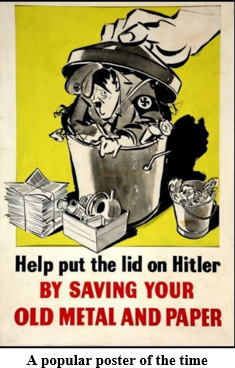
Previously, in 1941, in order to preserve its own stocks, the United States stopped exporting scrap metal to the UK. The British government was therefore forced to seek an alternative source of obtaining iron and steel supplies.
While the response of the “Army of the Home Front.” did fulfil an essential need, they also produced the additional benefit of providing a welcome boost the Nation’s waning morale.
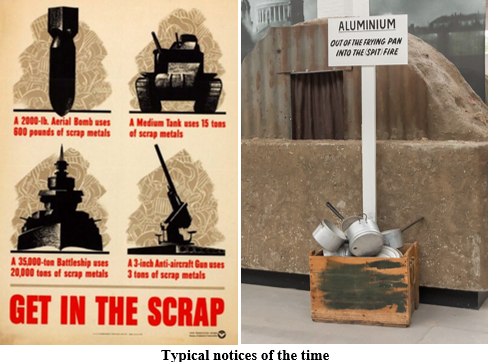
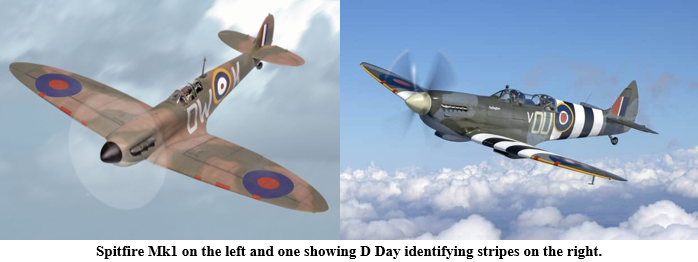
One of these initiatives, The “Saucepans for Spitfires” campaign has become a well-known piece of WW2 British home front historical lore.
In the summer of 1940, Minister of Aircraft Production, Lord Beaverbrook launched an appeal concentrating on gathering in aluminium while promising, tongue in cheek, to turn these old pots and pans into fighter aeroplanes, like the Spitfire.
The idea being that the nation’s bits of redundant machinery, broken gardening tools and other pieces of reusable metal would be turned into much needed munitions.
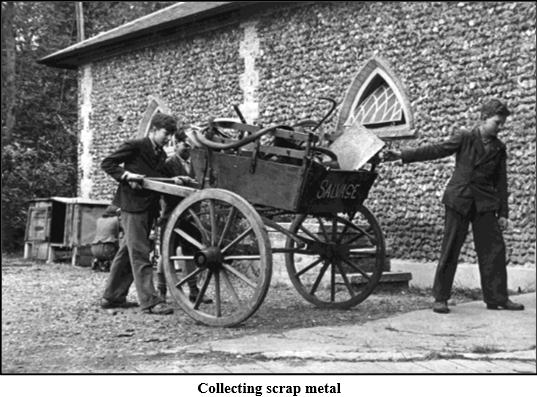
Youngster were encouraged to form small scrap collecting teams (The Author was a member of one.) and many a street fight developed over who had the right to get what from where.
Each of these little ‘gangs’, officially referred to as “Junior Salvage Stewards”, had its own secret storage area. But kids being kids, where these hoards were kept could not stay secret for long and quickly became a target for another gang’s raiding party, determined to add any pillaged goodies to their own secret store and so on.
Fortunately though, all of this disputed material did eventually find its way into a government collection depot. So all’s well etc.
Butchered bones were also collected, to make glue for aircraft assembly and to provide glycerine, a vital ingredient in the manufacture of explosives.
Although the propaganda campaign “Pots and Pans for Spitfires” was highly successful in boosting the morale of the civilian population, it was seriously flawed in that the low-grade scrap metal it produced was, in general, unsuitable for the requirements of modern aviation.
A Spitfire’s airframe had to be constructed of a special, high-grade aluminium alloy so that it was able to withstand the high speed of routine flight and to cope with the massive stresses experienced during combat. As a result, no flight-worthy Spitfire was ever built entirely from scrap.
What was collected though, was put to other military uses. So fortunately all was not lost.
*
WHOOSH! THE RAILINGS HAVE DISAPPEARED.
What follows about the ornamental railings, is a blend of wartime propaganda, logistic mismanagement, and enduring folklore. To separate fact from myth, generations of historians and researchers have investigated the garden railings mystery, without success
My memory:
It came about so suddenly that it was hard for me to comprehend. Why had all the park’s railings disappeared overnight? Where had they gone?
As a six year old on my way to school, I could now cross over the low wall that yesterday had been the base for a barrier of railings denying me access to a shortcut across the park.
Then it began to sink in. Everyone I knew was collecting scrap metal and taking it to a local collection place. It just didn’t seem right though, that the removal of these beautiful old railings, was in the same league as collecting old tyres, paper, tin cans, broken toys, old pots and pans and the like.
Anyway from that day on, now that I could step over the low wall, I did.
What We Know.
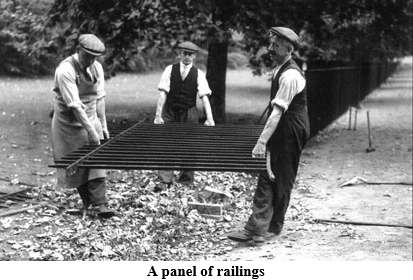
As part of this nationwide scrap metal salvage campaign it was decreed that, in villages, town and cities across the whole of the UK, all garden railings erected after 1850 (with the exception of those of historic interest) were to be cut down and removed. The meant that, throughout the land, millions of tons of railings disappeared overnight.
All of this salvaged ironwork was then stockpiled in places well away from public view.
Rumour, Hearsay and Evidence
While there is no shortage of eye witness accounts of people seeing the railings being taken away (the Author included), there is no mention at all of lorry-loads of railings arriving at the gates of steelworks to be fed into their blast furnaces.
So what did happen to all of the salvaged ironwork?
One school of thought believes that the material collected, was found to be unsuitable for reuse. Another, suggests the more likely explanation that, far more was collected than was actually needed or could even be processed.
Even when faced with an oversupply the bureaucrats, aware that the scheme was providing ordinary citizens with a welcome boost to morale as well as allowing them to feel they were making a personal contribution to the nation’s fight against the Nazis, rather than stop it, allowed it to continue.
It was estimated that during the course of the war over one million tons of scrap iron was collected. However, we now know that only around 25% of it was used for munitions, the remaining 75% must therefore have been hidden away in landfill sites, quarries and the like; or otherwise disposed of.
Although some of this material did eventually filter its way through to the post-war metal industry, the majority of it was left to rust in council depots, or left in old railway wagons parked in remote railway sidings in widely scattered places around the countryside.
Was there an official cover-up?
We have no way of knowing, because, during one of the government’s routine administrative purges, simply to clear space, thousands of temporary wartime logistics files at the Records Office were destroyed
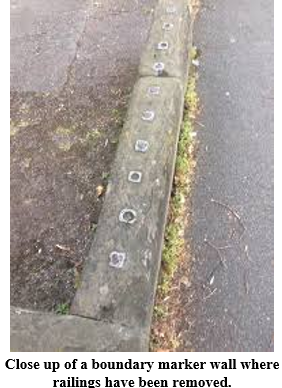
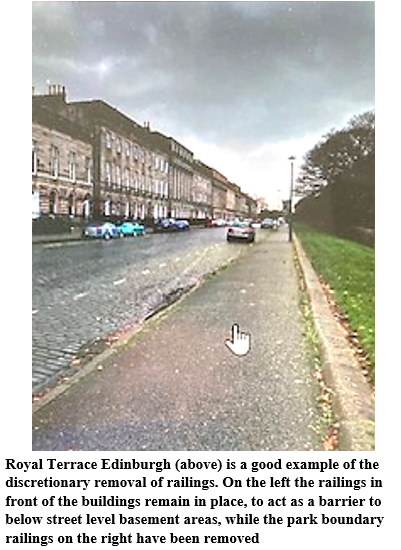
Meanwhile the whole of the U.K. is now left with the legacy of low walls with iron stumps set in lead where iron railings once stood.
*
Speculation
In 1978, London East Enders, who had worked in the Docks during the war years tell of barges, fully laden with panels of garden railings, heading downstream, to dump their ‘cargos’ somewhere in the Thames Estuary.
Other more fanciful explanations have also surfaced: one featured in a WW2 aircraft website, has a contributor claiming that, “towards the end of the war, when the RAF was running out of munitions, bombers flying over France were simply loaded up with lumps of cut-down railings which were dropped on the enemy”?
Another unverified account tells of the salvaged ironwork being used as ballast in ships going to Africa, with verbal reports coming back telling of houses surrounded by decorative Victorian gates and cast-iron railings that can still be found near ports on the West African coast.
Meanwhile the whole of the U.K .has been left with a legacy of the enigmatic stumps where railings used to be.
Post War
After the war, even although raw materials were still in short supply, the widely held view was that the government did not want to reveal that the removal of so much of nation’s highly valued ironwork that they quietly disposed of at sea; or buried in remote landfill sites, had been in vain,
It is also a well-documented fact that after the war, along with our own redundant military equipment, a massive amount of captured enemy munitions and equipment was dumped in the Irish Sea. Who knows, it may well be that a lot of the surplus scrap railings went there too.
However, no firm conclusion can be arrived at!
*
SOME INTERESTING ASSOCIATED FACTS
Iron Bandstands
Another element of this campaign saw the closure and demolition of bandstands throughout the U.K.
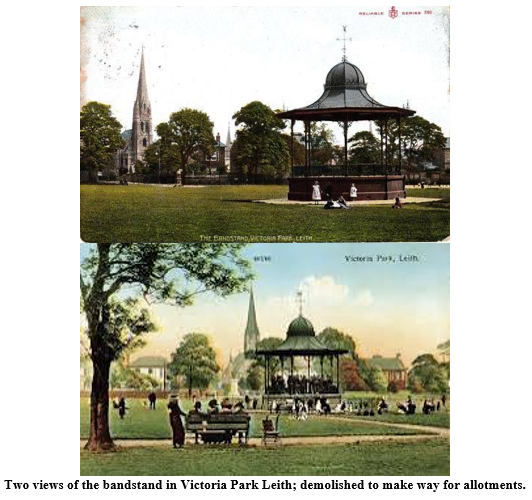
Due to, safety risks, blackouts, and the limited number of people available to run public events, many were simply boarded up.
Of those that remained a significant number went on to suffer from neglect, bomb damage or were just abandoned. When peace was restored, many of these structures remained closed, leaving us with a dearth of bandstands from the Victorian-era.
Today, only about 350 of the original 1,200 remain.
*
Emergency Stretchers
During the Blitz, the London Air Raid Precautions (ARP) department manufactured thousands of emergency metal stretchers to carry the wounded. More than 600,000 of these stretchers, with a kink in the frame so they could be lifted easily, were made.
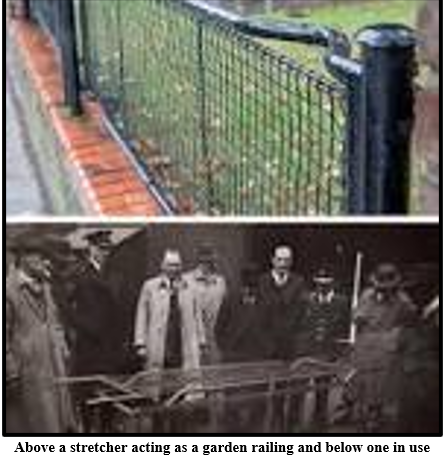
After the war a few of the London local councils ‘upcycled’ some of the leftover steel stretchers and used them to replace the old iron railings that had been taken away. This is why “stretcher railings” can still be found outside post-war housing estates across south and east London today.
These newly erected barriers, now recognised as important architectural and social historical artefacts, were painted black – many of original ones were green. The mesh panel, of some, still shows slight deformities that show where the hips and shoulders of the casualties lay, all these years ago.
*-*
Johnny Jones
P.S
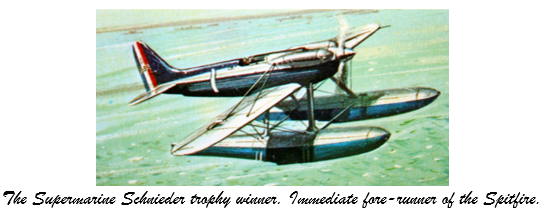
The streamlined shape and the low drag, liquid-cooled engine pioneered by Schneider Trophy designs are obvious in the British Supermarine Spitfire.


Johnny, what a fascinating account! Your childhood memories bring the Home Front vividly to life, while the mystery of the vanished railings reveals the uneasy relationship between patriotic enthusiasm and government mismanagement. I especially enjoyed the resourcefulness of repurposing wartime stretchers. Thank you for preserving this remarkable history!
LikeLike
This is fascinating history, speculation included. I wonder if Britons were told that the collection drives were over for having exceeded expectations, wouldn’t that be good news? Anyway, thanks for all this important telling.
LikeLike
Thanks for your kind words. A very good point made which would be great news indeed.
Kind regards
Johnny
LikeLike
THE OLD HOME GUARD AND ITS OFFSPRING WERE KEPT QUITE BUSY DURING THE WAR, WEREN’T THEY? TOO BAD SOME OF IT COULD HAVE BEEN RETURNED AND A HISTORICAL PLAQUE PUT UP, TO REMIND FUTURE GENERATIONS OF THE PRICE OF BRITISH FREEDOM.
LikeLike
Thanks Jonathan. Sacrifices made on all sides I imagine, but good point regarding a plaque to recognise the efforts by ordinary citizens.
Johnny
LikeLiked by 1 person
THANK YOU, SIR!
LikeLike
Thanks for this entertaining and fascinating account of how the public was brought into the war effort in Britain.
LikeLike
Never knew that.
LikeLike
Thanks Jacqui, there is a lot of information that is not in the public domain from all wars.
I am glad that I was there to witness the gathering of metal for the war effort.
Johnny
LikeLike