
THE PRINCE OF WALES
A SAILOR’S LOG (Part 2)
Continuing from this story about the battleship the Prince of Wales and reconstructing the life of a young sailor who was member of her crew for the whole of her short 6 months of life.
1.6 Ships Diary
In trying to make a stab at where Jimmy had been and the decorations he was awarded, I have created a Ships Diary for the full service life of the battleship The Prince of Wales:
It should be remembered that while you are reading the following that the Prince of Wales only went to sea as the principal vessel in a flotilla of warships and other support vessels.
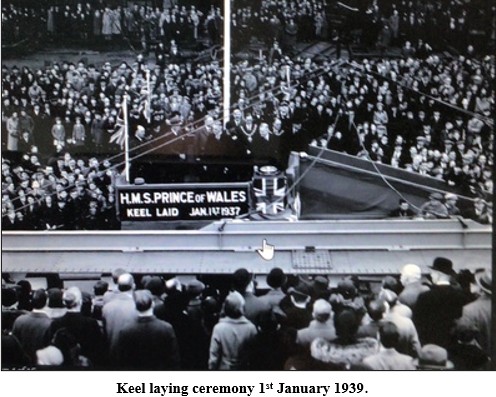
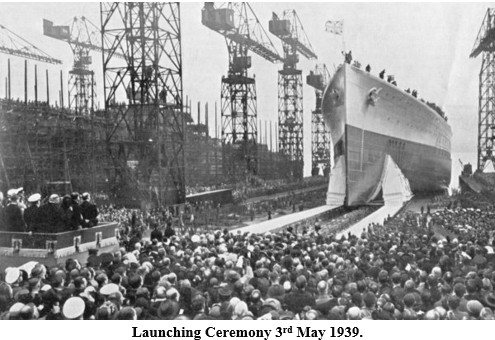
Day one, 1st January 1939, Keel laid
January 1941
19th – Commissioned, incomplete, and with only half of her crew, for trials.
28th – 1200 hours sailed from the Mersey
29th – 1300 hours off Cape Wrath,
30th – 1445 arrived at Rosyth for completion of fitting out
February
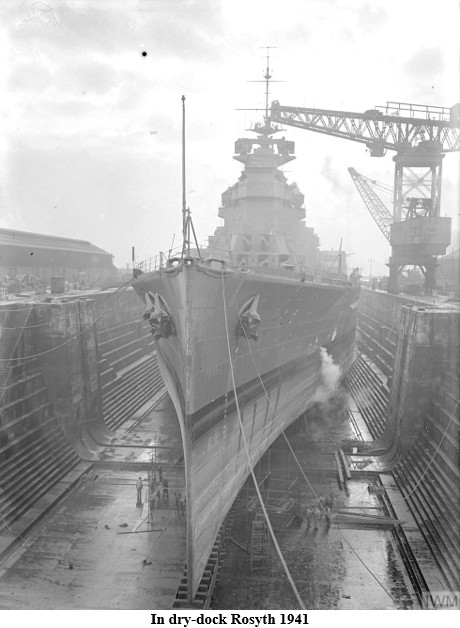
1st to 28th – Fitting-out at Rosyth
March
1st to 23rd – Fitting-out at Rosyth
Completed on 31st March 1941,
24th – With workers from Cammell Laird and Vickers Armstrong still on board, sailed from Rosyth for Scapa.
25th – arrived at Scapa.
26th – commenced working up exercisers.
April
1st to 26th – at Scapa Flow carrying out working up exercises
May
8th – 20th carried out Full Power Trials.
21st – reported to C-in-C Home Fleet as ready for service.
(The PRINCE OF WALES had less than two months of working up, which was completely inadequate when one considers all the new systems that were installed and the fact that 80% of her crew were “Hostilities Only” and had never been on a ship at sea before.)
21st – Left Birkenhead to join Hood Force charged with intercepting Bismarck
22nd – 0100 hours joined Hood Force and left Scapa Flo to patrol the Denmark Strait
23rd – 19:22hours AB Alfred Newell the starboard lookout of the heavy cruiser SUFFOLK spotted Bismarck in the Denmark Straight, between Greenland and Iceland.
23rd – Midnight, Action Stations,
24th – 0552 hours the HOOD opened fire on the BISMARCK at a range of approximately 25000 yards.
24th – 0553 hours the PRINCE OF WALES opened fire on BISMARCK.
24th – 0555 hours BISMARCK and PRINZ EUGEN returned fire.
The Battle of The Denmark Straights had begun
25th – 0620 hours disengaged to join the Home Fleet
26th – continued steering for Hvalfjord, Iceland.
26th – 1100 hours, heads for Iceland to refuel.
26th – Burial at sea of those killed was carried out.
27th – 0530 hours arrived at Hvalfjord.
28th – sailed from Hvalfjord for Rosyth.
30th – arrived at Rosyth.
June
1st – Rosyth under repair.
July
1st to 18th – Rosyth under repair
19th – 0600 hours departed Rosyth for Scapa Flow.
20th – 1930 hours re-joined the Home Fleet at Scapa Flow.
End of July – selected for a special operation, Code word RIVIERA.
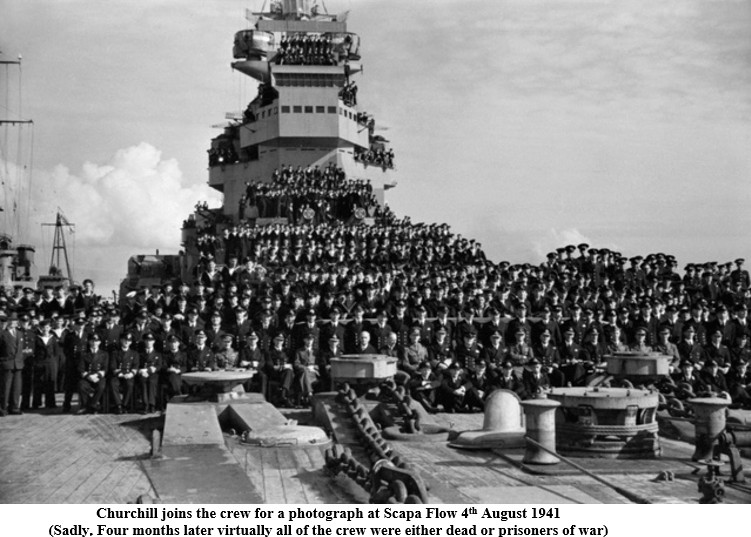
(Sadly, Four months later virtually all of the crew were either dead or prisoners of war)
August:
4th – 1130 hours the Prime Minister Winston Churchill, and staff came aboard.
4th – 1300 hours sailed from Scapa Flow for Newfoundland.
9th – 0700 hours arrived in Newfoundland where Winston Churchill met secretly with Franklin D. Roosevelt.
12th– Left Newfoundland for Hvalfjord
15th – 1500 hours, flying the signal ‘Bon voyage’, the Prince of Wales .closed with convoy HX. Churchill stood at the rail waving and the ships of the convoy hooting in return. Churchill enjoyed the experience so much he had Captain Leach reverse course and repeat the manoeuvre.
16th – 0900 hours refuelling at Hvalfjord…
16th – 2045 hours left Hvalfjord for Scapa
18th – 0900 hours arrived at Scapa. Churchill returned to London.
19th – fitting and trials of Type 273/M/P Radar,
26th – 0930 hours the First Lord of the Admiralty embarked, and carried out an inspection of the ship.
19th – to end of month possibly on Arctic Convoy duty.
September:
1st – to 8th. – Scapa Flow carrying out working up exercises.
9th – Scapa Flow where early in the morning on one hour’s notice following the report that German heavy cruiser ADMIRAL SCHEER had departed Oslo.
11th – resumed working up exercises.
15th – September departed Scapa Flow for the Clyde.
16th – 0730 arrived off Greenock nominated for deployment with Force H to cover Malta convoy GM 2, Operation HALBARD.
17th – approximately 1000 hours sailed from the Clyde.
17th – 1800 hours took station on convoy WS 11X off Orsay.
24th – 1500 hours arrived at Gibraltar for refuelling.
24th – 2345 hours sailed from Gibraltar
27th – 1302 hours engaged with two Italian planes that both crashed into the sea.
27th – 2010 steered easterly to re-join convoy to Malta.
October
1st – At 2000 hours departed Gibraltar for Scapa Flow.
20th – Orders from the Admiralty to despatch to the Far East as the flagship of acting Admiral Sir Tom Phillips, the newly appointed C in C Far Eastern Fleet
20th – loading ammunition for special job ahead
23rd – 0700 hours departed Scapa Flow for the Clyde.
24th – arrived in the Clyde and at 1500 hours departed the Clyde for Freetown.
November
5th – arrived at Freetown.
7th – departed Freetown for Cape Town.
15th – Crossing the Line ceremony
16th – arrived at Cape Town.
18th – sailed from Cape Town for Port Louis, Mauritius.
23rd – arrived at Port Louis refuelled and sailed the same day for Addu Atoll (Port T).
26th – 1745 hours arrived at Addu Atoll to refuel.
27th – 0840 hours sailed from Addu Atoll for Colombo.
28th – arrived at Colombo
30th – 10.00 hours rendezvoused with the REPULSE, in the Johore Straits to form Force G, which then set off for Singapore.
December
2nd having been to four continents in four months, arrived in Singapore with no air cover because, the British aircraft carrier Indomitable – proposed flagship of the then Force Z, heading to Singapore – had run aground near Jamaica in the Caribbean on 3rd November 1941.)
4th – Force Z in Sembawang naval dockyard
8th – Force Z in Sembawang naval dockyard.
(Meanwhile at 0025hours the first Japanese troops went ashore at on Sabak Badang Beach, Kota Bharu, in northern Malaya. This was 35 minutes before the attack on Pearl Harbour.
At 0305/8/12/41, landings were made at Singora, Kra Isthmus, Thailand)
8th – 0413 a signal was received from the Admiralty stating ‘Commence hostilities at once’, and at 1735 hours Force Z sailed northward from the Sembawang naval dockyard.
9th – (Kota Bharu airfield had been evacuated and were ‘losing a grip’ in the other northern airfields, due to enemy action)
9th 0400 hours Force Z altered course to turn northward. And at 0620 hours HMS VAMPIRE reported an aircraft sighting, but as only one lookout report it this information was disregarded.
9th 0800 hours Force Z was east of the Anamba Islands steering northward. The weather were showers and low cloud, ideal conditions for evading the enemy.
(At 1343 hours in approximate position 5N, 106E, Force Z was sighted by the Japanese submarine I-65.
9th Between 1700 and 1830 hours the weather cleared and three Japanese reconnaissance aircraft were sighted by lookouts on the PRINCE OF WALES
2.0 Noteworthy Extracts from ‘The Diary’.
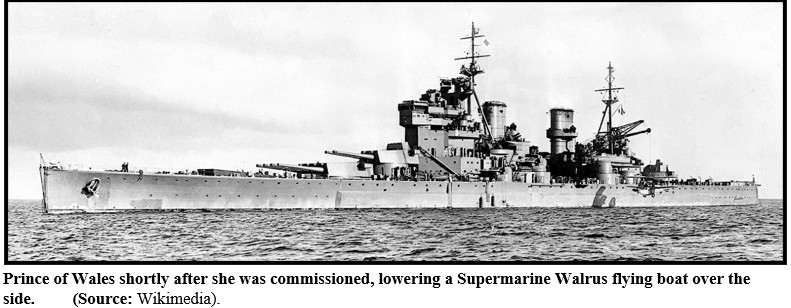
2.1 Churchill meets Roosevelt
Towards the end July 1941 the PRINCE OF WALES was selected for a special operation, codenamed: RIVIERA.
August 1941
4th – at 1130 hours the Prime Minister Winston Churchill, and staff came aboard. Then at 1300 hours sailed from Scapa Flow for Newfoundland.
9th – at approximately 0700 hours arrived in Newfoundland where, in Placentia Bay, Winston Churchill met secretly and with Franklin D. Roosevelt.
12th – Left Newfoundland for Hvalfjörður a Fjord in Iceland.
15th – At about 1500 hours in approximate position 60N, 34W the PRINCE OF WALES closed on convoy HX 143 (Ex Halifax on 5/8/41, 73 mercantiles escorted by the AMC WOLFE, destroyer BURNHAM and corvettes AGASSIZ, GALT, LEVIS and MAYFLOWER).
Churchill ordered Captain Leach to steam straight through the middle of the convoy while flying the signal ‘Bon Voyage, Churchill! At the masthead’.
Throughout the sail past, Churchill stood at the rail waving, while the ships of the convoy hooted in return.
Churchill enjoyed the experience so much he had Captain Leach reverse course and repeat the manoeuvre.
16th – At 0900 hours the PRINCE OF WALES arrived at Hvalfjord, took on fuel and at 2045 hours left for Scapa..
18th – At 0900 hours the PRINCE OF WALES arrived at Scapa. Where Churchill disembarked and returned to London.
2.2 The Battle of the Denmark Strait and the Sinking of the Bismarck.
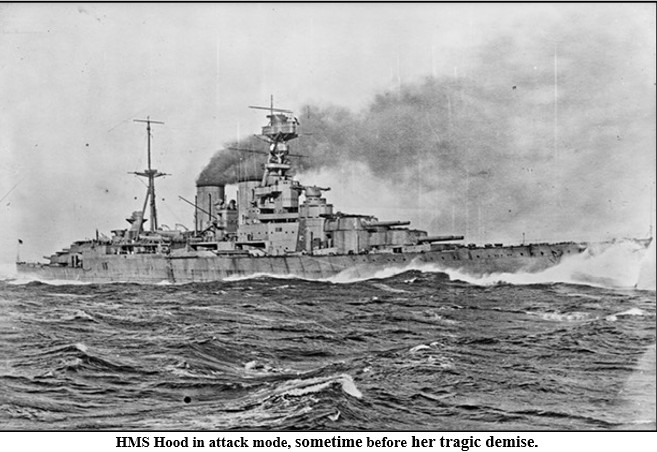
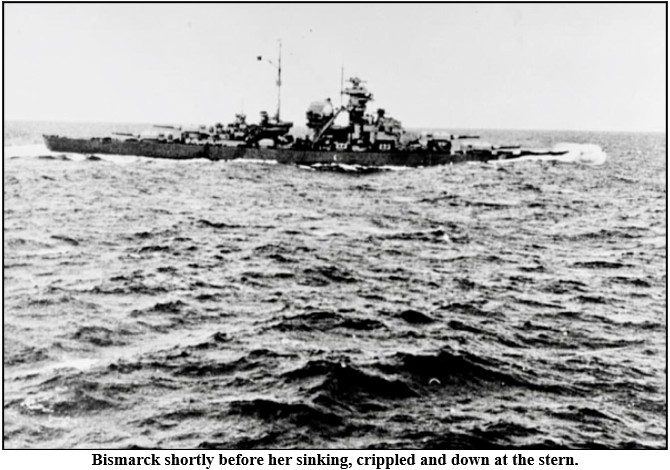
The battle brought to light the vulnerability of older battlecruisers when faced with long range torpedoes and heavy-calibre plunging fire.
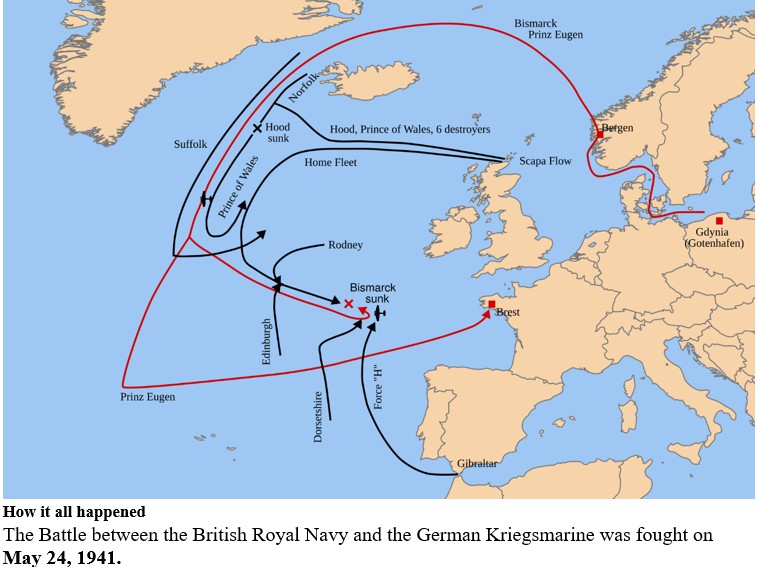
At 05:37 AM: British ships opened fire at a distance of roughly 13 nautical miles.
Prince of Wales struck Bismarck three times, causing a critical leak of fuel oil and reducing her speed. Prinz Eugen damaged Hood.
At 06:00 AM (The Turning Point): A 15-inch shell from Bismarck struck HMS Hood near her aft ammunition magazines. The resulting massive explosion tore the ship in half, sinking her in less than three minutes.
The conflict was a brief but critical World War II naval engagement. The result of which was an operational victory for the British, as it forced the German battleship Bismarck to abandon its convoy-raiding mission. However this victory was overshadowed by the loss of Britain’s largest battlecruiser, HMS Hoodalong with 1,412 of her crew. There were only three survivors.
The Prince of Wales, suffered severe malfunctions in her new, untested gun turrets and took damage from both of the German ships. She was forced to break off the engagement and retreat.
Damage to Bismarck’s bow meant she was losing fuel and leaving a visible oil trail, forcing her to abandon her mission and attempt to reach occupied France for repairs. The loss of the Hood infuriated the British and lead to a massive, relentless, three-day hunt by the Royal Navy, resulting in sinking of Bismarck three days later, on May 27, 1941.
2.3 The Atlantic Convoys
In 1941, the Prince of Wales played a prominent, though indirect, role in the Atlantic convoys. While she was not considered to be a dedicated convoy escort (a task usually reserved for destroyers and corvettes), her very presence was vital for the protection of the Atlantic lifeline from German surface raiders.
2.4 The Mediterranean Convoys
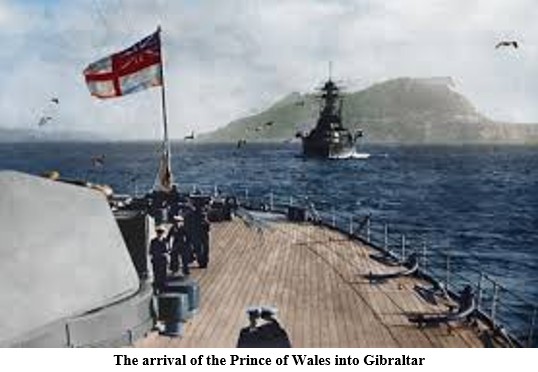
A typical example of two hours of hectic action that could happen at any time while on convoy duty on the Gibraltar to Malta run
Crew at constant Action Stations:
At 1000 hours, in expectation of air attacks, Force H, manoeuvred ahead of the convoy to join the convoy escort.
At 1158 hours radar detected an aircraft bearing 210 degrees, at 14 miles
At 1255 hours radar reported two formations at 30 miles and closing eleven torpedo bombers five Fiat CR 42 fighters. Seven of the bombers attacked from the north and four from the east.
At 1259 one bomber shot down.
At 1302 hours a torpedo bomber was shot down by either the PRINCE OF WALES or the RODNEY; the damaged aircraft collided with his right wingman, and both crashed into the sea.
At 1300 hours two torpedo bombers targeted Force F,
At 1303 hours two destroyers took evasive action to avoided torpedoes.
At 1327 hours radar reported another wave of aircraft closing from the east.
At 1330 hours two Italian aircraft were shot down by the combined AA fire of the PRINCE OF WALES and the SHEFFIELD.
At 1345 hours the Force was attacked by twelve torpedo bombers, escorted by twelve Fiat CR 42’s. Intense AA fire prevented any of them from attaining a dropping position.
At 1359 hours a Fiat CR 42 attempt to divert the AA from the torpedo-bombers, began to perform aerobatic manoeuvres over the heads of the starboard wing destroyers
At 1405 hours the edCR.42 shot down and crashed into the sea.
In the space of 2 hours three separate attacks were repulsed and the Italians lost 4 planes
*
2.5 The Voyage to join up with Force F
2.5.1 Crossing the Equator
While there is no public record or specific, well-known or high-profile “King Neptune Ceremony” or “Golden Shellback Initiation “documented, on 15th – November 1941 during its voyage to Singapore, the Prince of Wales crossed the Line twice. Firstly on the leg from Freetown to Cape Town and secondly in September shortly before arriving in Singapore.
A ceremony was held on the first crossing which is described in Geoffrey Brook’s excellent book ALARM STARBOARD as “A hilarious ceremony, during which, all of the officers were daubed with chocolate that had gone bad in the canteen, then whitewashed and ducked.”
When the second crossing was made, all hands had already been adopted into Neptune’s Kingdom, so no crossing the line ceremony was required.
However, by crossing the line twice and the record-breaking manner in which they did, saw the crew create a, symbolic “Equator Crossing Certificate” ceremony, which was well received by all on board.
*
2.5.2 Arriving in Cape Town
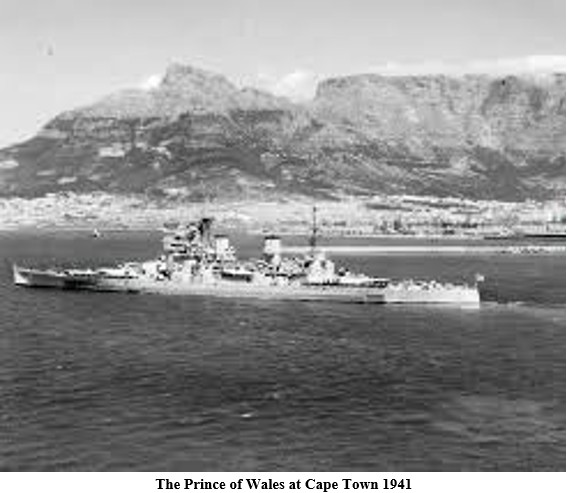
2.5.3 Arriving in Singapore
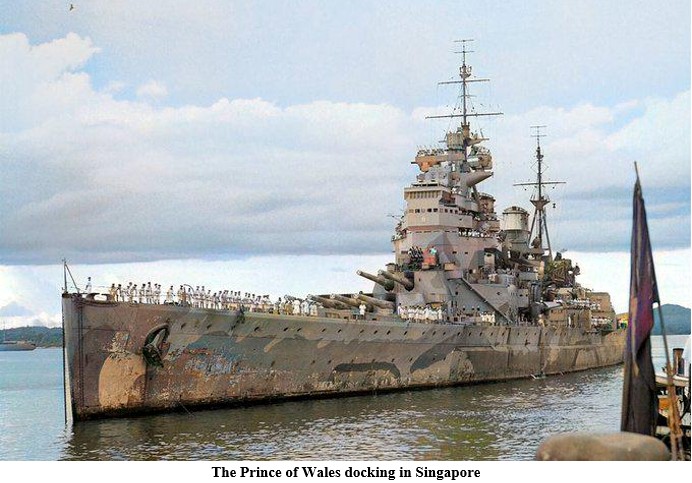
The Prince of Wales docking in Singapore
*
2.6 The Loss of Force Z
Force Z led by Admiral Sir Tom Phillips had been assembled to deter Japanese aggression in Southeast Asia, arrived in Singapore on December 2, 1941.
It left Singapore on December 8 to intercept convoys of Japanese landing troops and supplies in Malaya.
The loss of Force Z on December 10, 1941, was a major WWII naval disaster. That was the day when both the British battleship HMS Prince of Wales and battlecruiser HMS Repulse were sunk by Japanese aircraft, off the coast of Malaya,
This event was highly significant in that for the first time ever, capital ships operating at sea, were sunk by air power alone.
To the Nation, it was unthinkable that the unsinkable had been sunk. Unfortunately, worse was to follow when, shortly afterwards, the unassailable garrison of Singapore was overwhelmed and forced to surrender.
This also signalled a massive shift in naval warfare as carrier-based air power took over from what had been battleship supremacy.
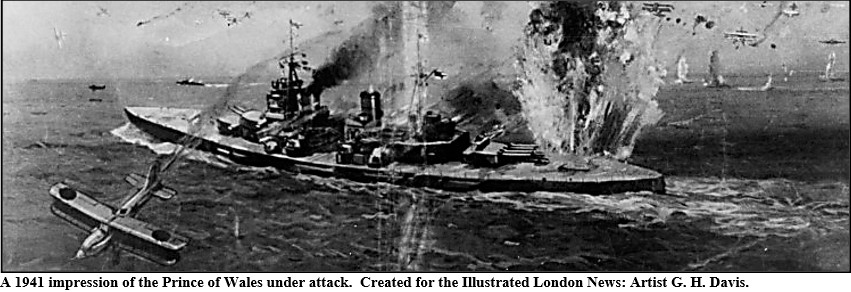
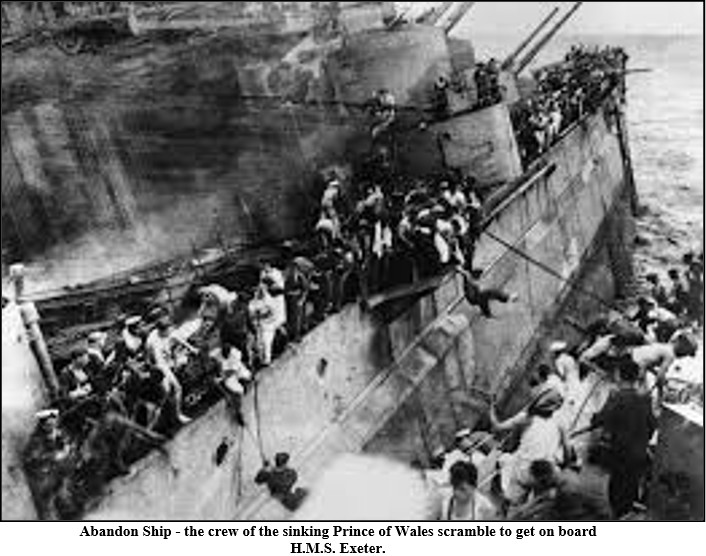
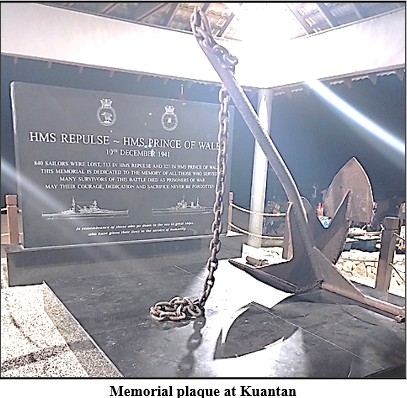
On December 10th, lacking air cover due to the absence of a carrier and exacerbated by a failure to secure support from the RAF, the depleted Force F was attacked by 85 land-based Japanese bombers and torpedo bombers. HMS Repulse was sunk at 12:33 PM, after being hit by Japan’s new long range torpedoes, followed almost an hour later by the Prince of Wales at 13:23 PM. Over 500 men from Repulse and 330 from Prince of Wales were lost.
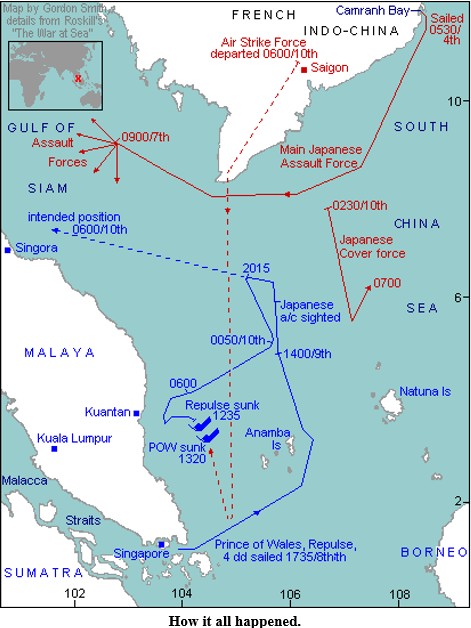
The Key Factors affecting the Loss were: Force Z had no air cover (Its intended flagship aircraft carrier, HMS Indomitable – after running aground near Jamaica, in the Caribbean – was still in dock for repairs) leaving the fleet without its essential “air umbrella”.
Admiral Phillips underestimated Japanese naval air capabilities, believing they could not fatally damage modern, manoeuvring capital ships. The Japanese however had utilized well-trained, land-based “Nell” and “Betty” bombers that successfully combined high-level bombing with new long range torpedo attacks.
The Strategic Impact of the destruction of Force Z, combined with the attack on Pearl Harbor, crippled the naval power of the Allies in the Pacific and opened up the way for the surrender of Singapore and the rapid expansion of the Japanese Empire.
*
3.0 The Medals Jimmy Earned.
The ships diary has provided me with sufficient information to allow me to determine which medals Jimmy was entitled to.
Here is a breakdown of the medals a crew member serving aboard the Prince of Wales would have earned in its brief but active World War II career
- 1939-1945 Star: Awarded for operational service.
- Atlantic Star: Awarded for service in the Atlantic and home waters, including the chase of the Bismarck. (He is wearing this ribbon in his portrait photo.
- Pacific Star: Awarded for service in the Pacific/Indian Ocean, covering the final deployment and loss of the ship
- Italy Star: This Star is awarded for service afloat in the Mediterranean, often needing to have already earned the 1939-1945 Star.
- Defence Medal: Awarded for non-operational or home service, often worn with the campaign stars.
- War Medal 1939-1945: Awarded for 28 days or more full-time service.
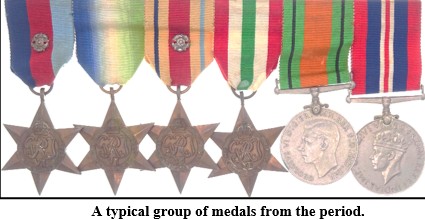
Whether all of Jimmy’s medals were ever issued has yet to be determined. The author is in communication with the appropriate authority.
*
4.0 Conclusions;
I believe that Jimmy joined The Prince of Wales in 1941 before she was commissioned as part of the fitting out crew, and served on her until she got to Singapore.
Then, sometime before The Prince of Wales sailed on her last fateful voyage, he was posted to the Singapore Shore Base, HMS Sultan, where he was admitted to the Alexandra Hospital. So, fortunately, he was in hospital when his ship went down.
Following the fall of Singapore Jimmy became a Prisoner of War.
During their incarceration, prisoners were strictly disciplined and severely punished by the Japanese, for even the smallest of transgression, Food was barely edible and was of next to no nutritional value. Supplies of medicine were minimal and practical hygiene was in general non-existent.
Somehow Jimmy managed to survive the Alexandra Hospital Massacre – often referred to as the St Valentines’ Day Massacre (February 14-15, 1942).
This inhuman and shamefully callous rampage occurred when Japanese soldiers first entered the hospital and set about killing wounded patients in their beds. Many were bayonetted, some even as the lay on the operating tables.
The medical staff and orderlies were rounded up and held overnight.
Next day they were all systematically killed.
Up to 300 people were brutally murdered in the course of this, horrendous, bestial, two-day, atrocity.
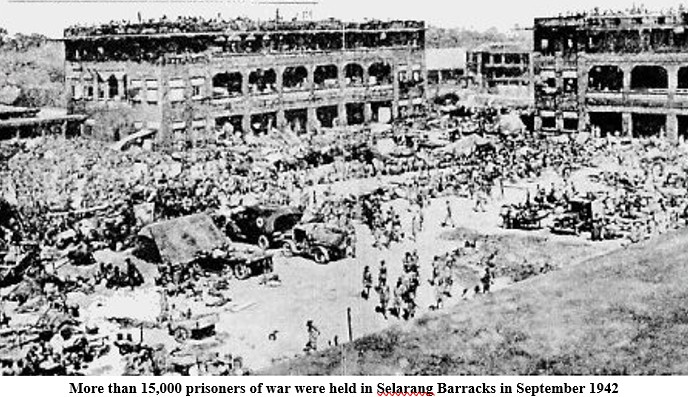
Jimmy would then have remained in prison in Singapore until the Japanese captured the island of Sumatra. Then he would have been transferred to Pelambong prison camp on Sumatra. While he was there he would almost certainly have worked in a forced labour group, repairing airports roads and railways. It is also very likely that he would have worked on the new North to South Railway line being built in central Sumatra.
From the day he joined the navy Jimmy crammed more memorable interludes of adventure, excitement and action into his life than I’m sure he would ever have dreamt of.
By the time he left his ship he had visited four continents, crossed the line twice and in spite of the horrors of war he was involved in, we knew that during his voyage to Singapore although he would have experienced a fair number of days of routine sailing he would have relished the camaraderie of his messmates and enjoyedthe pleasures ofwhatever shore trips he took in the ships exotic ports of call.
As a morale boosting bonus he got to meet Winston Churchill – until recently the First Lord of the Admiralty – informally and was able to chat with him a comfortable and intimate manner?
Who knows, Jimmy might even have met Franklin D. Roosevelt as wel. Another colossus of the war years.
Regrettably, after spending 19 months in captivity, Jimmy died of dysentery in Sumatra on 5th Sept 1943. He was only 22 years of age.
*
Jimmy’s final resting place has yet to be ascertained as – judging by what is shown on the photo of his grave in Palembang Cemetery Djakarta – I am of the opinion that this could well be a temporary one.
Sometime in the next few months, when I get a copy of Jimmy’s service record, this, and a few other possible anomalies, could all be finally resolved.
Jimmy’s life, like so many of his fellow combatants of WW2, may have been a short one but he managed to pack a lot into it, some of it good, some not so good!
Footnote: What Jimmy deserved but did not survive long enough to enjoy.
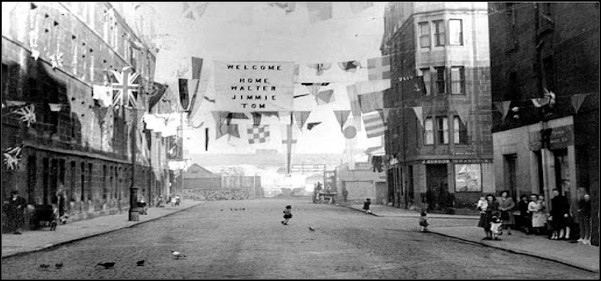
Graham Street Leith in 1945 decked out to welcome home 3 ex Japanese prisoners of war.
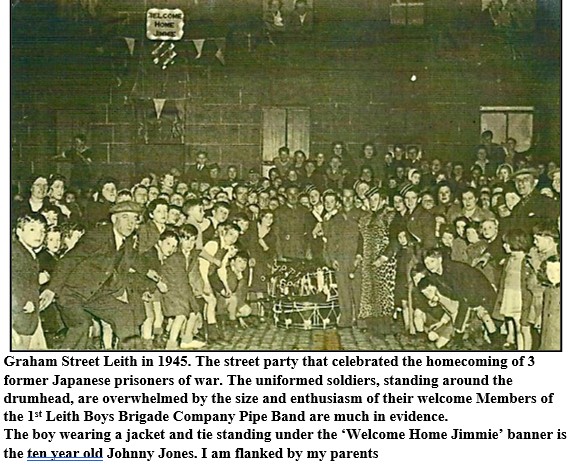
It is ironic to think that one of the returning heroes was called also Jimmie!
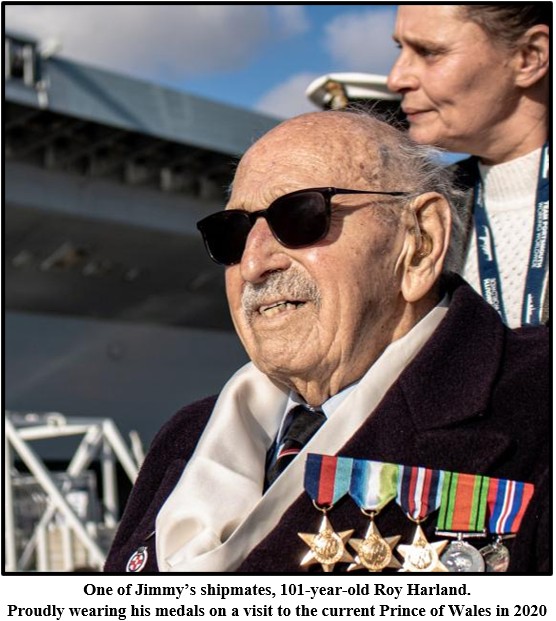
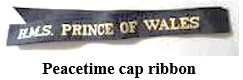
*The present day Prince of Wales Aircraft Carrier was commissioned at Portsmouth on 10th December 2019, 78 years to the day after her predecessor (the WWII-era battleship HMS Prince of Wales) was sunk in 1941.
References and credits
ALARM STARBOARD Geoffrey Brooke Publisher Pen & Sword 2019.
ONE YEAR OF LIFE Alan and Gordon Franklin Publisher William Blackwood and Sons 1944.
SERVICE HISTORIES of ROYAL NAVY WARSHIPS in WORLD WAR 2 by Lt Cdr Geoffrey B. Mason RN Rtd. (c) 2003. Editing and Additional Material by Mike Simmonds.
Postscript: I will issue a new post when I eventually hear from the War Records Department.


EXPERIENCING IT WITH YOU IS FAR MORE REWARDING SIR THAN READING IT FROM A BOOK! THANK YOU SIR FOR THIS OBVIOUSLY INTENSE LABOR OF LOVE!
LikeLike
Thank you Mighty Mumford 🙂
LikeLike
What a fantastic job you’ve done Johnny. Well done.
LikeLiked by 2 people