
Wartime Memories Number 6
A SAILOR’S LOG
A riveting look back to the battleship, Prince of Wales and a bit by bit, reconstruction of the momentous experiences of a young sailor from Edinburgh who served as a member of her crew for the whole of her short 6 months of life.
1.1 A Memory Jolted.
When, in 2018, my wife and I embarked on a cruise out of Rosyth, (the old and still operational, naval dockyard near Edinburgh) my brain pulled a trigger that fired up a wartime memory.
We had just got on board, emptied our cases, had a bite to eat and decided to take a walk around what was to be our home for the next two weeks.
On opening a door to go out onto the promenade deck our view was completely blocked by a wall of grey paint.
As we watched the wall slid slowly past, telling me that what were seeing was the side of an enormous ship sailing past us.
My brain immediately clicked into gear. For the last year or two I had been reading articles in the local newspapers about Britain’s new front line aircraft carrier that was in the process of being fitted out in Rosyth dockyard.
To me therefore, this could only be one ship, The Prince of Wales, eighth in the line of that name and the immediate successor to the one on which my cousin had served during WW2
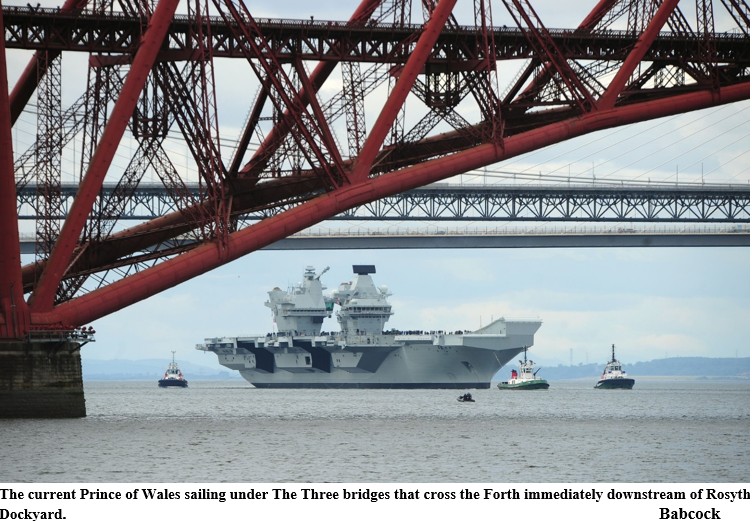
The present day The Prince of Wales is an aircraft carrier. On 8th September 2017 at Rosyth dockyard, she was formally named by Queen Camilla (then the Duchess of Rothesay). Later on 21st December 2017, she was floated out of Rosyth dry-dock and moored to a nearby jetty for fitting-out.
She left Rosyth for the first time on 20th September 2019 and remained at anchor, in the Firth of Forth, until tidal conditions were right to allow her to pass under the 3 bridges across the Forth.
On 22nd September HMS Prince of Wales passed under the three Forth bridges and out to see to begin her sea trials.
As see in the following two photographs, the present day ship, the Prince of Wales.
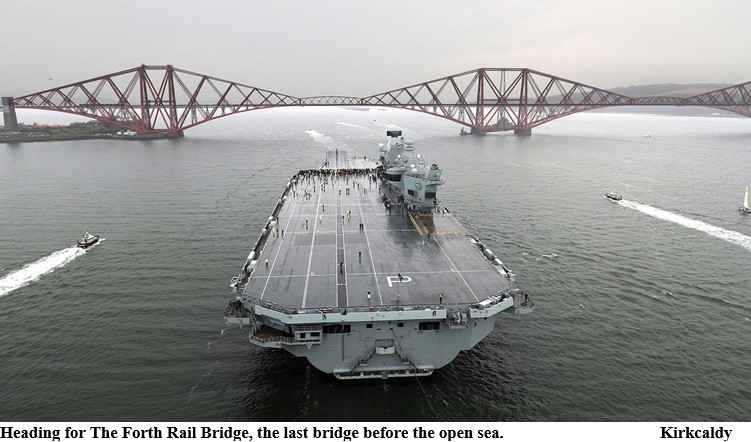
Heading for The Forth Rail Bridge, the last bridge before the open sea. Kirkcaldy
1.2 A Trip Down Memory Lane.
As we stood watching the wall of steel moving slowly past us my memory took another jump, this time into the past and brought back thoughts of the 1937 battleship The Prince of Wales and of my cousin Jimmy who sailed on her.
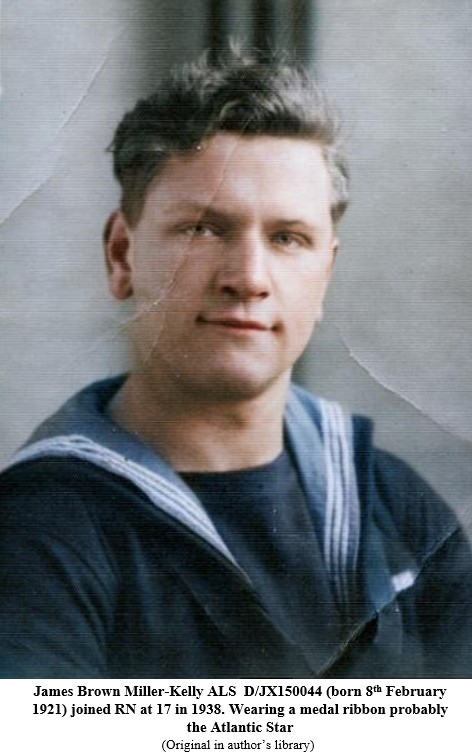
(D/JX150044: is his Royal Navy service number. The “D/” prefix indicates that he was enrolled in the Western Approaches command or a specific naval base/drafting port, likely Devonport. In 1939. The “JX” prefix indicates the type of engagement, specifically a general service engagement for hostilities during the period of the Second World War)
I was four years’ old when my cousin and surrogate big brother Jimmy, joined the Royal Navy and later (very likely in the spring of 1941) joined the crew of The Prince of Wales – one of Britain’s new George V Class battleships. This means that he was a member of her crew from the day she first went to sea until she arrived in Singapore on December 1941
A flood of childhood memories then ran through my head: images of old black and white photographs of him and other scraps of flimsy memorabilia I had about him.
Principally though I thought back to when, as a 10-year-old, I used to stare with pride at a faded photograph of him standing beside Winston Churchill on the deck of The Prince of Wales. Both of them looking out to sea.
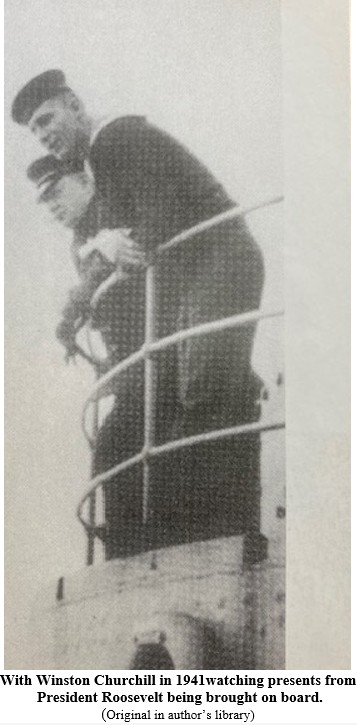
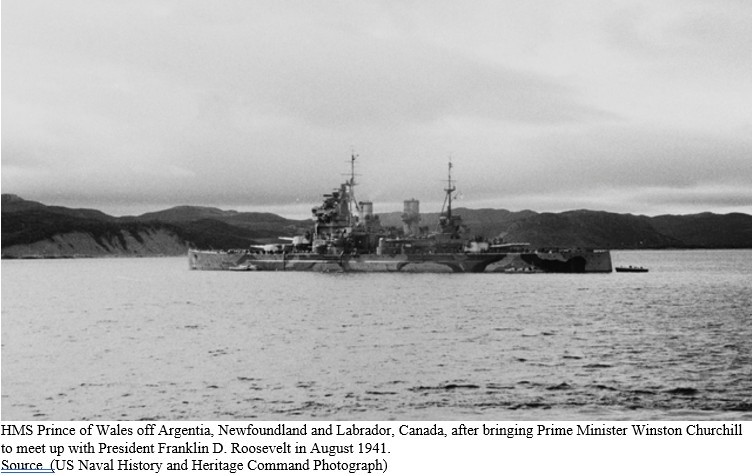
Until May 1940 Churchill was the First Lord of the Admiralty:
After completing this mission the Prince of Wales went into dry dock at Rosyth and was based there from 30th May 1941 until 18th July 1941. During that time, Jimmy occasionally managed to get home to see his family. On one of these visits he came to our house. While he was with us he gave my mother a blue tea cosy decorated with an image of his ship, under way, inside a sailor’s collar. I got a cat o nine tails he had made for me. (Both of these items I gave to his brother and sister some time ago.) My father got Jimmy’s portrait photo (now colorized above and a copy of the one showing his meeting with Churchill.
That visit sadly turned out to the last time I saw him.
1.3 What I Believed Then.
I had always considered Jimmy’s ship to be invincible, a real giant and one I believed he would be safe on. After all, with her innovative extra thick armour plating and big guns she was reputed to be unbeatable and unsinkable. Even when she was fighting at sea I just knew Jimmy would be alright.
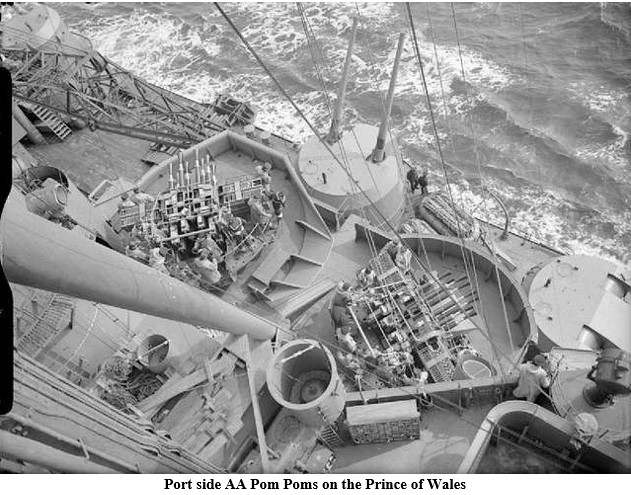
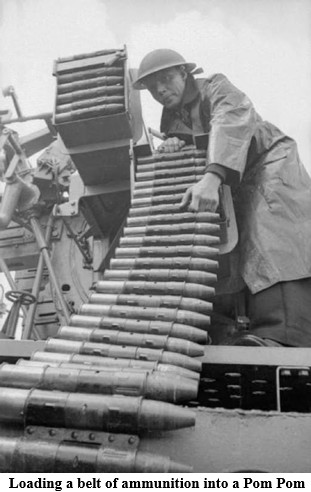
I was also remembered his frequent visits to my parent’s house where, as the son of her favourite big brother, my mother always fussed over him. And later, when he came to see us when he was on leave, telling us about his grand life at sea and how proud he was to be a Pom-Pom* gunner on the best ship in the fleet.
*The “pom-pom” was a 40mm (2 pounder) British close-range anti-aircraft (AA) autocannon that was used by the Royal Navy during World War II. It was commonly set up on 4 or 8-barrel mounting to create a high volume of fire. Its name came from the distinctive sound it made when firing.
My mind stayed in the past as I recalled Jimmy’s mother – my Auntie May – showing me a letter from him on his trip to the Far East, its thin pale blue envelope with South African stamps on it and still smelling faintly of salt and diesel. In it Jimmy described dark balmy tropical nights, flying fish, and of how it was rumoured that the Prince of Wales was on its way to the Far East.
I remembered too imagining Jimmy standing on the bridge of his ship, heading off to somewhere at the other side of the world, looking out resolutely at a horizon filled with golden sunlight. A paradise a million miles away from the dreary, rainy, winter days of Edinburgh. Jimmy was a hero!
As an avid reader of adventure stories in the DC Thomson comic books like the Hotspur, Wizard and Adventure, I knew all about heroes and I was sure that Jimmy was simply waiting for that not-too-far distant day when he would come home to us. He would be smiling and full of the joys of living and I would relish hearing more of his exciting tales about his life as a sailor.
I did not believe that it even remotely possible that my hero would come to any harm.
In those days I was not really old enough to understand the true nature of the dangers he faced every day and just how precarious life was, on a ship at war.
My train of thought did not stop there. It took me to when we heard of how The Imperial Japanese Air Force had attacked Pearl Harbour and the seemingly impregnable American naval base on Hawaii, while almost simultaneously the Japanese Army carried out a sea-borne invasion of the Malayan Peninsular. And how, over the next few days, the BBC newsreader commented on the Japanese army’s apparently unstoppable progress towards Singapore. I was also reminded of how he always tempered this unthinkable eventuality by stating firmly and confidently that the enemy forces would be stopped when they reached the impregnable fortress of Singapore itself.
So much for his well-intentioned propaganda because it was only a couple of months later that the garrison forces of Singapore surrendered (An act that stuck in my mind from newsreels that clearly sickened the soldier who carried the white flag).
From that day on everything took on a different meaning for me. Singapore was where Jimmy’s ship was based. Where was he? What was happening to him?
This also took me back to how the voices of the adults in the family suddenly became quieter and how their faces were now drawn and tight.
Any time I asked Jimmy’s mother about him, she would just hug me closely, perhaps just a little too closely and try to reassure me with words of comfort. I just did not understand why anyone could think that the sea was a dangerous place.
Then came the blow. It happened when a number of family members were gathered together at my grand-parent’s home. I was sitting in a chair, reading a Biggles book and the radio was on. I was barely listening. I just wanted the war to end so that Jimmy could come home to us and play football with me again.
Suddenly a programme of dance music was interrupted by static, followed by a hum. A solemn voice then said, “Today the Prime Minister announced that yesterday, his Majesty’s capital ships, the Prince of Wales and her sister ship the Repulse were sunk by Japanese aircraft somewhere off the coast of Malaya. The loss of 840 men is also confirmed, including Admiral Tom Philips and Captain John Leach”.
An eerie hush engulfed the room, one that quickly became the muffled sound of whimpering and silent sobbing before the stunned silence was broken by unrestrained screams of, “No!” “Why?” and “What?”
From that day forward information from the Far Fast was, on the whole, extremely patchy until eventually, with the passage of time it dried up altogether.
That day was 11th December 1941.
1.4 What I know about Jimmy now.
Everyone in the family knew that Jimmy had survived the Alexandra Hospital Massacre – often referred to as the St Valentines’ Day Massacre (February 14-15, 1942) – This was where Japanese soldiers entered the British military hospital, bayoneting wounded soldiers in their beds, some even on the operating table. Medical staff and orderlies were rounded up, held overnight, and systematically killed the next day. Up to 300 people were brutally murdered in this two-day atrocity.
However, we also knew that although he had become a prisoner of war he had not come back from the war.
I was then struck by how little I knew about him, particularly, after the sinking of the Prince of Wales. So, I asked his sister if she could help me. She told me that somewhere she had a small envelope containing material about him that she had inherited from her mother, my Auntie May. She promised to look this out for me and give it to me on my next visit. Which she did.
It turned out that the envelope she gave me contained a couple of photographs and a few items of correspondence with Government departments. all of which were completely new to me. (I will deal with these items in what I believe to be a chronological order.)
1.5 Images of the items in the Envelope.
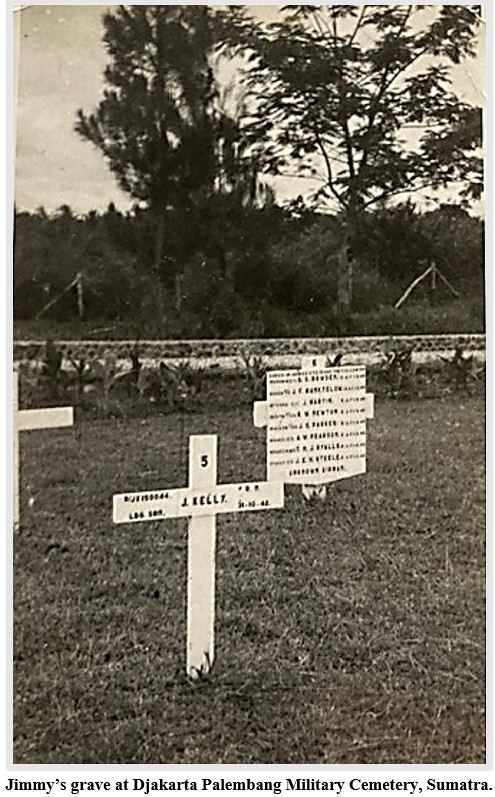
The back of the above postcard reads “ Three days by sea from Singapore. A really beautiful place, the graves are well tended too”.
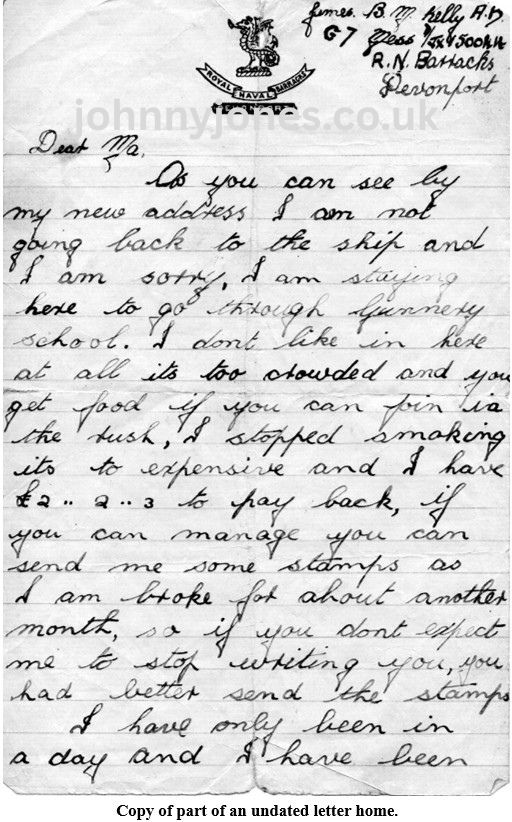
Jimmy has come off a ship and is now on a course at the Devonport School of Gunnery. A course that normally lasted 6 weeks. From here he would almost certainly have been posted directly onto The Prince of Wales.
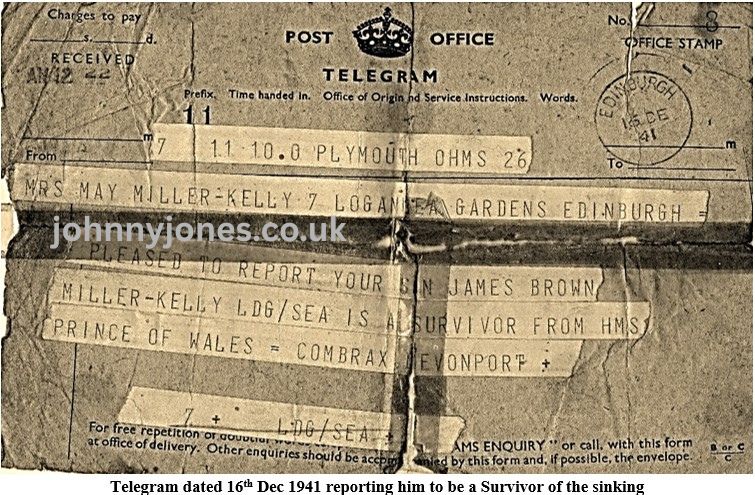
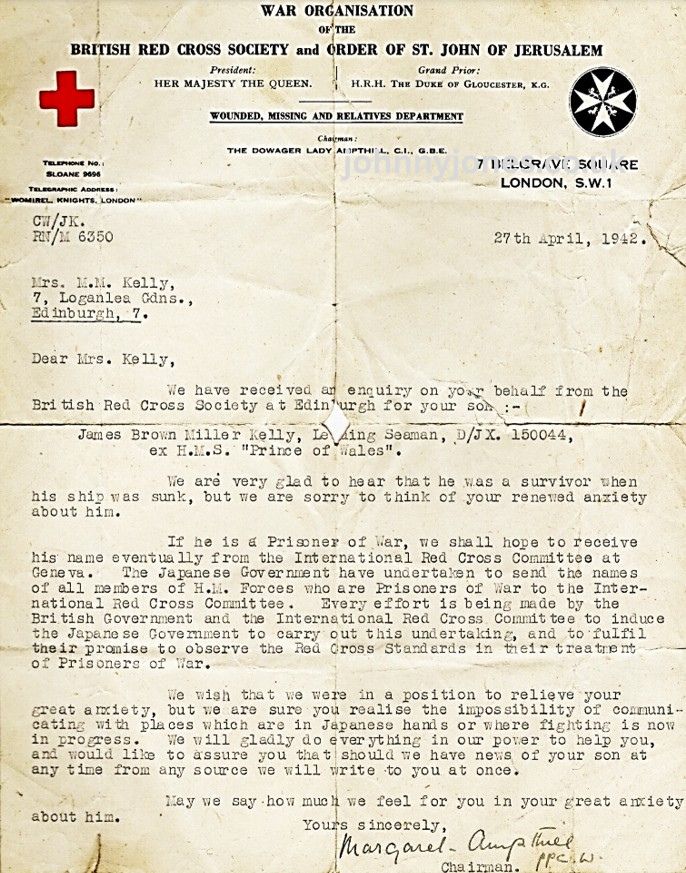
Letter of 27th April 1942
This letter indicates that the family had heard nothing about Jimmy since the telegram of 16th December 1941. An anxious period of waiting and uncertainty of more than 4 months!
Although Navy personnel, held as Prisoners of War by the Japanese during World War II, were allowed to send letters and postcards home, such communication was highly restricted, extremely sporadic and heavily censored. At the end of the war, when Prisoners of War camps were liberated, many thousands of prisoner’s letters were found stored in dust covered mail bags their onward delivery having been blocked by their captors.
The Japanese authorities were also very slow in releasing mail for onward delivery, with many letters arriving over a year after they were sent.
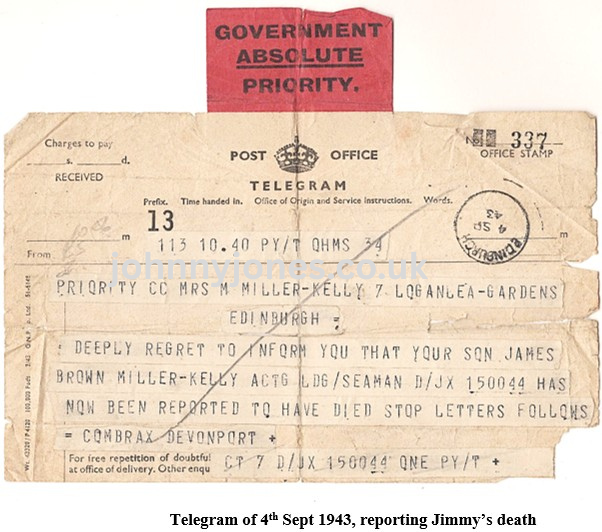
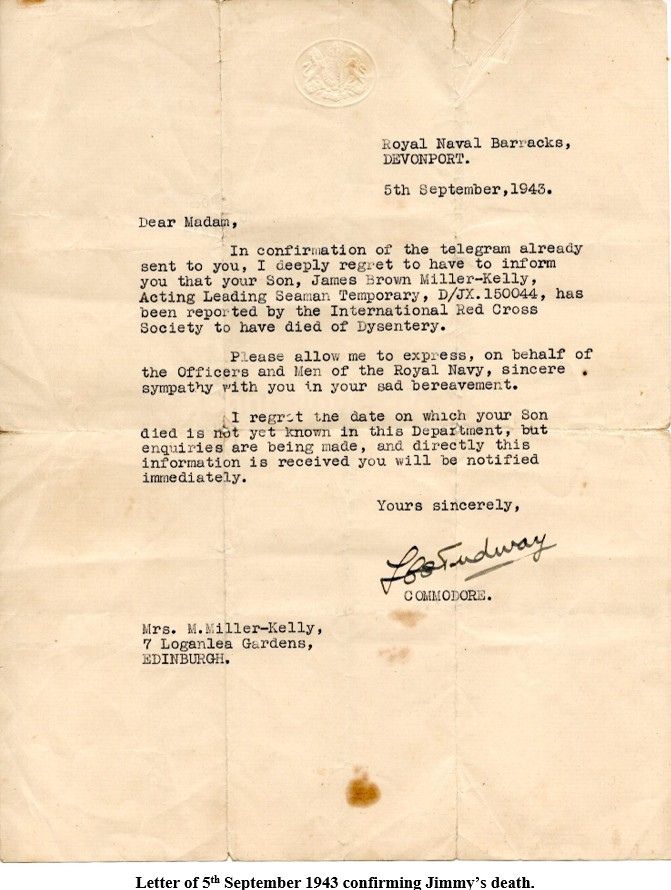
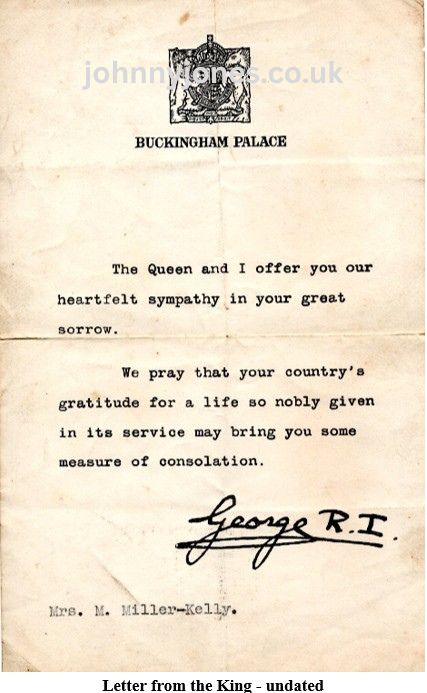
To be continued, in the final part of this post which will be released May 30th 2026.
Thanks for sharing this with me.
Johnny Jones


Old memories, beautiful 😍
LikeLiked by 3 people
Thanks Priti
LikeLiked by 2 people
🙏🏼
LikeLiked by 1 person
A sad, yet wonderful, account of an important part of your family history Johnny.
LikeLiked by 2 people
Thanks Peter, many emotions involved when researching these accounts. Regards Johnny
LikeLiked by 2 people