
Wartime Memories No.3
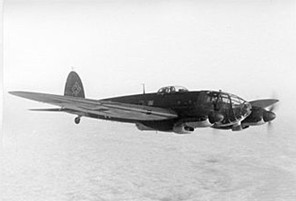
German bomber of the period – (Heinkel He 111 H)
CHRONOLOGICAL SEQUENCE OF THE EARLY LUFTWAFFE AIR RAIDS
- On November 13, 1939 the first bombs of World War II dropped on British soil landed at Sullom, Shetland, (The raid was largely ineffective and failed to hit any of its naval targets.)
- March 1940 saw the first death of a British civilian when James William Isbister was killed during a German air raid on Orkney.
- 7.45pm on 18th July, 1940 marked the first air raid on mainland Britain.
- August 24, 1940 saw the first German air raid on London* which hit the central part of the city killing civilians and prompting Britain to retaliate by bombing Berlin. *This raid is now considered to have been accidental
- September 7th 1940, Hundreds of German bombers attacked the docks in eastern and southern London and marked the start of The Blitz, a sustained bombing campaign focussed on attacking London and other principal cities throughout mainland Britain – Aberdeen, Glasgow, Clydebank, Coventry, Hull, Cardiff, Bristol, Belfast and many more. Two million houses were damaged or destroyed (60 percent of these in London and more than 40,000 civilians were killed and a further 46,000–139,000 were injured.]
*This shows a deliberate change in German bombing policy, from attacking air defences to trying to demoralizing the civilian population.
DATES OF AIR RAIDS ON EDINBURGH DURING WW2
- June 26, 1940 at 0.55 a.m. Five 250kg bombs and 100 incendiaries landed in open ground near Craigmillar Castle Road, no-one was injured.
- July 18, 1940 at 8.07 p.m. 12 bombs were dropped. Two landed in the sea, two 250kg and six 50kg bombs in the vicinity of the Victoria Dock Leith: at junction of Commercial Street and Portland Place, at Nos. 8 and 13 George Street, at the LMS railway coal depot of the Newhaven branch line (which did not explode) and in Nicol Place. This was the air raid I witnessed. (See below in What I Remember)
- July 22, 1940 at 5.59 a.m. One 1000kg bomb landed beside Albert Dock, three 50kg bombs on railway lines and 48 incendiaries in Seafield Road. Total casualties for raids 2 & 3, 8 killed and several injured.
- July 22/23, 1940. Overnight 100 incendiaries fell in the Granton area, no-one was injured.
- August 4, 1940 at 1.30 a.m. Five bombs landed in Portobello: in Abercorn Park, at 9 Abercorn Terrace, at Christian Path near Argyle Place and at 84 Argyle Crescent. None of which exploded.
- September 27, 1940 at-7.58 p.m. Two 250kgbombs fell. One in the grounds of Holyrood-House and the other in a playing field at the west end of Kinnear Road. No-one was injured
- September 29, 1940 at 5.15 a.m. One 500lkg bomb fell in Duff Street. Leith
- September 29, 1940 at -7.45 p.m. One 250kg bomb on 21/23 CrewePlace.Total casualties for raids 7 & 8, 3 killed and several injured
- October 7, 1940 at 7.45 p.m. Five 50kg bombs landed between Warrender Park Road and Melville Drive. They struck 16 Roseneath Place, the roadway opposite and also at 12, 13, 14 Marchmont Crescent and 21 Marchmont Road. Another one landed at 20 Meadow Place but didn’t explode. 11 injured in total.
- November 5, 1940 at 8.10 p.m. Six 250kg bombs landed on Pinkhill House, Corstorphine, hitting the Zoo aviary, a zoo pathway, a stone quarry near Corstorphine Hill Avenue and two in Clermiston House grounds. no-one was injured
- March 14/15, 1941 overnight 70 incendiary bombs landed in Abbeyhill area. No-one was injured.
- April 7th, 1941 at 11 p.m. 2 Landmines, one on David Kilpatrick School, and another on the railway embankment opposite Largo Place, Leith, 34 incendiaries on Corstorphine-Dalmeny line and on Braehead House, Cramond Brig. 3 killed 132 injured. Incendiaries were dropped on \Corstorphine and Cramond but were immediately snuffed out by the Civil Defence Forces.
- May 6th, 1941at 00.36 a.m. One 1000kg bomb at the rear of 28 Niddrie Road and three 50kg bombs fell on numbers 18, 23, 43 Milton Crescent; also 100 incendiaries landed on Jewel Cottages, Niddrie Road. 5 killed 2 injured
- August 6th, 1942 at 11.20 p.m. Four 500kg bombs were dropped on 35 Loaning Crescent, near the junction of Loaning Road with Loaning Crescent, on Craigentinny House and on the adjacent vacant ground. 2 killed several injured.
- In May 1944 a lone JU88 made a high-speed low -level strafing run on Edinburgh. However no record of the effect or injuries were found.
WHAT I REMEMBER
When, as a 5 year old, I was ‘helping’ my father to apply criss-crosses of Scrim (adhesive tape) to the windows of our North facing second floor tenement flat in the Bonnington area of Leith. (Scrim tape applied to the inside of a window was used to protect those inside from flying glass)
My father (who after being turned down for active service – because of his advanced age – had volunteered to become an auxiliary fireman, warden and plane spotter) pointed out of the window and in a voice charged with emotion, gasped.
“Look over there son, there’s a German plane!”
Not quite understanding what was going on, I followed the line of his pointing finger and saw, above and beyond the rooftops on the other side of the road, an aeroplane, flying slowly from left to right against the background of a grey overcast sky,
As I watched, anxiously holding my breath and with my little heart pounding, I saw what appeared to be a small part of the plane detach itself and fall, tumbling slowly, downwards towards the ground.
Shortly afterwards I heard the muffled crump of an explosion, followed almost immediately by the ominous sight of an expanding cloud of grey black smoke spiralling slowly up towards the sky.
From our window in rural Edinburgh, my Dad and I had just witnessed, the first bomb of the Second World War being dropped by Luftwaffe on the United Kingdom. A tragic event that caused the first civilian fatalities in mainland Britain’s of the Second World War.

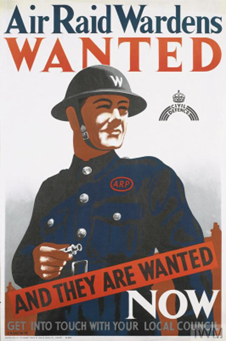
My father Alexander Jones and a typical poster for wardens during the war years.
WHAT THE RECORDS SAY.
“At around 7.45pm on 18th July 1940, a single enemy plane flew out of the early evening clouds, dropped a single bomb that sounded the death knell for the, up ‘till then, unscathed citizens of Leith.
The plane then went back up to altitude and circled, before releasing its remaining two 250 lb and six 50 lb bombs.”
That first bomb had exploded in the tenement building, at 8 George Street, Leith, (now North Fort Street), brought down the building, produced significant collateral damage and caused the death of seven innocent civilians.
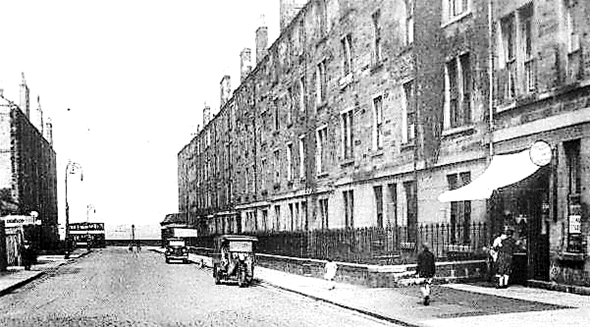
George Street, Leith looking North before the bomb, No 8 is in the middle of shot on the right.
(Sourced from The Spirit Of Leithers)
Later, when the plane dropped the remainder of its bombs, on its next pass, they landed very close to where it’s first one had landed and caused significant further sorrow, destruction and devastation, as described next.
The first bomb of that second run fell on Commercial Street, close to its junction with Portland Place, where it exploded just a few yards in front of a stationary tramcar and left a huge crater. All of the tram’s glass windows were blown in by the blast but amazingly, none of the 20 people on board were injured.
Some of the remaining bombs landed, in the LMS railway coal depot on the Newhaven branch railway line. One came down in Nicoll Place and did not explode but it left a large crater in the road.
Wardens very quickly rounded up a group of children playing in the nearby streets and shepherded them into shelters. Houses in the immediate area were temporarily evacuated.
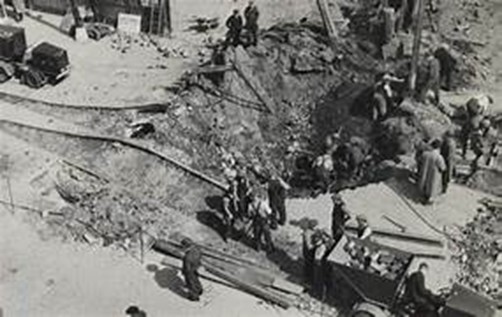
The bomb crater in Portland Place
Throughout the period of the raid no air raid sirens were sounded and no other form of air raid warning given, as a result, no-one had gone to the shelters. The unwitting citizens of Leith had just carried on with their normal daily lives, totally unaware that they had just been thrust straight into the front line of the Second World War
*
Later, in the day RAF fighters forced the plane that carried had out the raid down into the Firth of Forth where its slightly injured pilot was rescued and taken to Leith Hospital
While lying in his hospital bed he showed ‘typical Nazi belligerence and arrogance’. However when he was later shown the damage he had caused in George Street and told that his bombs had killed seven people, his whole attitude changed. It was reported that, on his way to a Prisoner of War camp, he was seen to shed anguished tears of remorse.
*
After the war both No.8 George Street and the adjoining tenement at No. 10 were demolished and a new block of flats built on the site.
To avoid confusion with the George Street in Edinburgh’s new town, the street name was changed to North Fort Street.

Block of flats in North Fort Street that replaced the bomb damaged tenements in what was George Street.
Edinburgh suffered 14 recorded air raids during the course of World War 2 but unfortunately they did cause the deaths of 21 of its citizens, while a further 210 of them were injured.
A day or so after each raid, my father would meet up with his Civil Defence colleagues in a wooden hut built into the Pilrig Street boundary wall of Pilrig Park. From where a local trader – another C.D man – would take them round the latest bomb damaged sites, in his open sided lorry, to let them see for themselves the effects of the most recent raid that had occurred within their area of responsibility. I, being the unofficial mascot of the group, was allowed to go with them.
I remember vividly, the nose-catching smell of burning that hung around everywhere. Avoiding large bomb craters. Seeing every window in sight blown in and shell-shocked victims just standing or wandering aimlessly around, listlessly picking over the dusty, ruins of their collapsed former homes, scavenging for any small scrap of what remained of their lost world.
Everywhere lay the remains of what had been buildings. Piles of dusty stonework scattered with parts of beams, rafters, broken furniture, grotesquely deformed household items, bits of broken glass and slate roof tiles, smashed pottery and fragments of photographs and letters. Pathetic items of ephemera that had once been the personal family treasures of these unfortunate victims of war.
Every single one of them still trying to comprehend what had happened in that terrible few minutes when their homes had been turned into smoking dusty rubble strewn ruins. Family, friends and neighbours, had been killed or injured. They had lost everything. Their lives had been irreversibly changed and things would never be the same again.
Even to this day when I pass through any of these places that I was taken round all these years ago I can still remember that a bomb fell over there. And often, by the differences in the character of a building or the small changes in masonry or brickwork, I can still pick out the exact spot of where ‘that’ bomb landed.

Low resolution aerial photo taken in 1946 shows Pilrig Street running diagonally down from top to bottom of the image. Rosebank cemetery is just left of centre, with Pilrig Park on the opposite side of the road. Bonnington Toll is at the top centre of the shot.
Note. Today, from the changes in the character if the stonework in wall of Pilrig Park boundary wall, it is still possible to see (blue arrow where the long demolished Communal hut used by the Civil Defence Services) used to be.
The total number of civilian fatalities in Edinburgh, directly attributable to WW2 air raids amounted to 21 people killed while a further 210 were injured
A significant number of other places in Scotland were subjected to air raids however this article is an account of the ones that affected The City of Edinburgh.
In all 60,595 British civilians were killed and 86,182 seriously injured in the course of the 5 years of the war.
A SOBERING AFTER THOUGHT
All of the foregoing may seem to be little more than a nostalgia trip, but it does serve to remind us that the scars of war take a long time to heal and that it takes the passing of a few generations for them to become lost to living memory.
SO WHY DOES THE WORLD GO ON MAKING THE SAME MISTAKES THAT IT HAS BEEN MAKING SINCE TIME IMMEMORIAL.
***
Further recommended and more detailed reading:
“This Present Emergency” by Andrew Jeffrey.
 Johnny Jones
Such important stories.
Gwen.
LikeLiked by 2 people
Johnny, this is a powerful and deeply affecting remembrance. The clarity of a child’s witness, set against the hard record of history, makes the human cost unmistakable. Thank you for preserving these memories—and for the sober reminder of how long the scars of war endure.
LikeLike
Very informative well shared👌👌
LikeLike
Thanks Priti 🙂
LikeLiked by 1 person
🙏🏼
LikeLike
What memories. Why do we keep repeating the same mistakes? I can’t answer that.
LikeLike
Einstein made a famous quote about this – “the definition of insanity is doing the same thing over and over and expecting different results”.
Thanks for taking the time to comment.
LikeLiked by 1 person
That covers most of us septuagenarians and older
LikeLiked by 1 person
Well written✌️✌️
LikeLike
Johnny, why we never learn from history is beyond me. Perhaps it pays for governments to wage war rather than foster peace. There are some interesting anomalies throughout history, such as British and German companies both buying ball bearings from the same neutral country during WW2. Money rules!
LikeLike
Egos getting in the way of common sense I guess. Thanks for your comments peter.
LikeLiked by 1 person
Interesting. Good to post and preserve history for future generations, Johnny
Best wishes
LikeLike
Many Thanks Craig, Regards. Johnny
LikeLike