


[*Supporting information on my article EDINBURGH’S BRIDGE OF SIGHS in the November/December2022 edition of the Edinburgh Life magazine* by Johnny Jones/ Jack Jones/John A Jones]
Hidden and Enigmatic Statue
I was born in 1934 and as a child every time my family walked over the Dean Bridge, my father would lift me up to let me see ‘The Little Sailor Boy’. He would tell me that the statue had been put there in memory of a sailor who had committed suicide by jumping off the bridge and that it had been put there to act as a warning to others who might be thinking of taking the same drastic way out.
Nowadays, hundreds of people walk or drive past the enigmatic figure every day, totally unaware of its existence.
The Statue
If you do happen to recognize the statue above you are one of a diminishing number of City folk who know where it is, have an inkling of why it is there but are unlikely to know a lot about what it commemorates and why it sits there.
The figure sits on top of a wall on Randolph Cliff beside the Dean Bridge, where it has been for at least 140 years. It is looking up at the bridge and its facial expression suggests that it is deep in thought.
Information about this statue, is not easy to find and actual written references to it are almost non-existent.

The Location
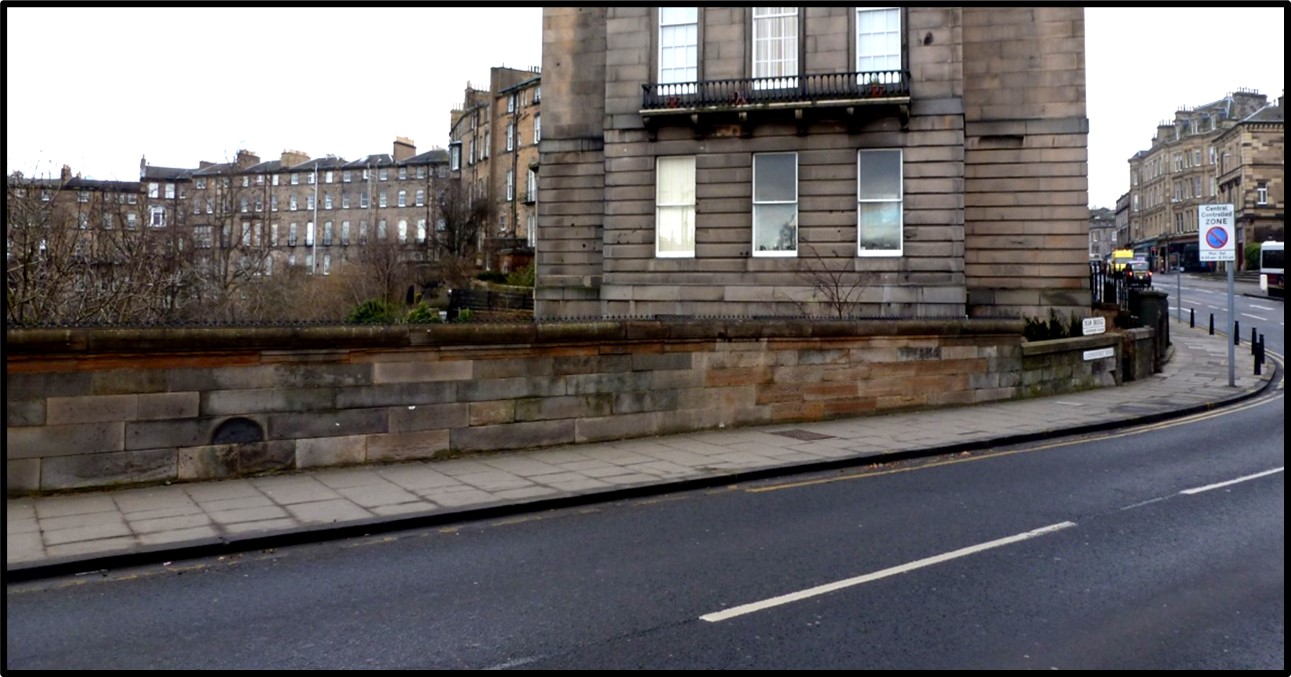
For those who do not know where it is, walk from the West End of Princes Street and head along the east side of Queensferry Road towards the Dean Bridge. When you get to the bridge, take twenty paces walk along the footway. Look down to your right and on the second course of the parapet wall you will see a black half-moon scorch mark in the stone, (see photo below). Now look over the wall and there, about 30 metres in front of you, you will see the slightly larger-than-life statue of a young man.
A few enigmatic questions will likely come to mind.
Who is it, why is it sitting where no one can see it and when was it put there?
With the passage of time, the statue has weathered somewhat, so that now its clothes can no longer be easily recognised as those of a sailor. The statue – hidden from view – has gradually drifted out of peoples’ mind until now there are few who can remember anything about it.
The statue in the garden.
N. B Please do not ring the doorbell of 7 Randolph Cliff as the current occupiers can add nothing to what is written here.)
In conversations I have had with some of the few people who were aware of the statue recently, the words ‘suicide’ and ‘sailor’ kept coming up. Viz.
‘A sailor was walking over the bridge with his girlfriend and in trying to impress her, told her that he would jump off the bridge with an umbrella – which he did and survived the fall. Emboldened by his feat of bravado he tried again, but this time he was not so lucky.’
to the more realistic and believable;
‘ It is in memory of a sailor who, when spurned by a lady, jumped to his death.
And it was put there to make others think again.’
Information about and written references to this statue are few and far between and are no longer easy to find. What I did manage to unearth however, were the following tantalizing clips,
- John Geddie refers to the statue on page 147 of his book, “The Valley of the Water of Leith.” published in 1898, in which he writes;
“……….over it the cliff rises almost perpendicularly …..The seated figure of a sailor on a garden wall above is, in the popular belief, the commemoration of a dire accident at this spot.”
- Another reference appears on p132 of R.G. Gordon’s “The Neurotic Personality”. published. in 1927;
“………. contrast this with the historic, if somewhat legendary sailor who tried to kill himself three times by jumping off the Dean Bridge in Edinburgh.”
A search in the Scotsman Archive showed that, since the bridge was built many letters to the editor have appeared in the columns of the newspaper. Almost without exception, these letters demanded that something be done to stop the appalling frequency with which disturbed souls threw themselves off the bridge. But there is only one letter which makes any reference to the statue, and even that is somewhat vague.
- ‘DEAN BRIDGE FATALITIES Manse of Little Dunkeld September 1907
“Sir, About a quarter of a century ago(i.e.1882) it was my sad experience to have a youth from my parish, who was employed in good office work Edinburgh, found one morning under the Dean Bridge. I wrote to your paper pleading for the removal, by those who have the power, of the hideous figure that suggests such earlier tragic incidents at the spot.”
“For some reason my earlier letter did not appear. There have been many cases since.”
“It is known to me that this “thing” is potent in suggesting to reeling brain and disordered nerves, what Mr. Primmer* reports in your issue yesterday. Intended perhaps to warn like the siren, it in fact allures;
Its Gaze is death and makes destruction please.”
In the name of 160 victims, of one known to me, a widow’s promising boy, I again try to direct public attention on this “horror” seated on the shelving rock of the Dean. Without this the Bridge could be no more a temptation to self-destruction than any of the other suitable places that are free from these calamities.
I am &c J.S.MACKENZIE’s
*Unfortunately Mr. Primmer’s letter of the day before made no reference to any statue.

I have studied the Moray Estate development and made up the following rough time line:
First 12 plots sold for development – 1822
Retaining wall built to contain a land slip in back (Bank) gardens – 1825
Bridgeworks started – 1829
Bridge Completed – 1832
Bridge opened up to pedestrians – 1832
Bridge opened up to traffic – 1834
Second land slip occurred – 1837
Additional west retaining wall with private access to Dean Bridge built – 1840
Randolph Cliff completed circa – 1858
Proposals to raise bridge parapet, put before City Council – 1888
Bridge Parapet raised – 1912
Probable answers to the earlier questions
1 From J.S.Mackenzie’s letter; we know that the statue was already in place by 1882. And further, from the Moray Estate timeline, the second (West) Dean Garden wall, on which the statue sits, was completed in 1840. Therefore we may assume that the statue was erected sometime between 1840 and 1882
2 Above written evidence provides further credibility to the suicide aspect
3 The statue can no longer be seen by anyone walking along the bridge because the parapet was raised in 1912.
4 As for who the statue represents, this, if it ever was an individual, is irretrievably lost in the mists of time.
THE DEAN BRIDGE AND ITS ENGINEER


Pre 1923 published engraving of Dean Bridge

Johnny Jones (Author) I.C.E Certificate – As a Bridge Engineer, the subject got me interested in researching this article.
Comments, corrections or any snippets of further information will be gladly received.
************************************************************

Copies available at Edinburgh local retailers & edinburghlifemagazine.com
Scroll down the page https://edinburghlifemagazine.com/buy-issues/ to Issue 76 and follow the instructions.
If you want a copy outwith the Edinburgh area, get in touch directly using the Contact page at Edinburgh Life or info at edinburghlifemagazine.com
Edinburgh Life is a glossy, bi-monthly magazine which celebrates the finer aspects of life in Scotland’s capital city.
 Johnny Jones
I have walked over that bridge many times (my mum lived in Great Stuart Street and I was down in Stockbridge for a couple of years) and never knew about the statue. Thanks for the all the info and history.
LikeLike
What an interesting story and a great reminder if people would learn the story of the statue. We all need to think carefully about our next step no matter what it might be.
LikeLike
Trus words Bev, thanks for your comment, Johnny.
LikeLike
This is fascinating – I had no idea it was there, and I go that way a lot! Thanks for sharing.
LikeLike
Hi and thanks for your interest. Regards Johnny
LikeLike
Your posts are always an interesting read. Thank you for sharing your knowledge. Cheers, Muriel
LikeLiked by 1 person
Thank you, Muriel for your kind comments as always.
LikeLike
Thanks for following!
LikeLiked by 1 person
Johnny, Your exploration of the mysterious sailor statue at Dean Bridge is fascinating. It’s intriguing how history and legend intertwine, creating a haunting yet captivating tale
LikeLike
Really interesting!
LikeLiked by 1 person
Thank you for this I really enjoyed read the history fiction, fact and fable 💜
LikeLiked by 1 person
You’re more than welcome!
LikeLiked by 1 person
Reblogged this on my travel blog in New Zealand
LikeLiked by 1 person
Love history – been to Edinburgh but our friends never told us this story. Thank you for your research of this fascinating legendary tale.
LikeLiked by 1 person